Turning data governance from entry into investigation
I changed the primary interaction model from maintaining metadata records to detecting, investigating and resolving data-quality problems—helping teams resolve anomalies 25% faster.
Case study summary
- Impact
-
- 25% faster anomaly resolution
- One flow from signal to resolution
- Advanced capabilities became everyday work
- System scope
-
- Metadata lineage
- Data-quality signals
- Guided remediation
- Contextual adoption
- Company
- Solidatus
- Ownership
-
- Product framing
- Workflow architecture
- Interaction design
- Adoption strategy
The decision I owned
Reframe the product
Stop optimising data entry. Make investigation and resolution the default path.
Users were treating a governance platform as a place to enter and clean metadata. Fixing isolated editing problems would have improved efficiency while reinforcing the wrong product behaviour. I shifted the centre of gravity towards finding, understanding and resolving data-quality issues.
The system before
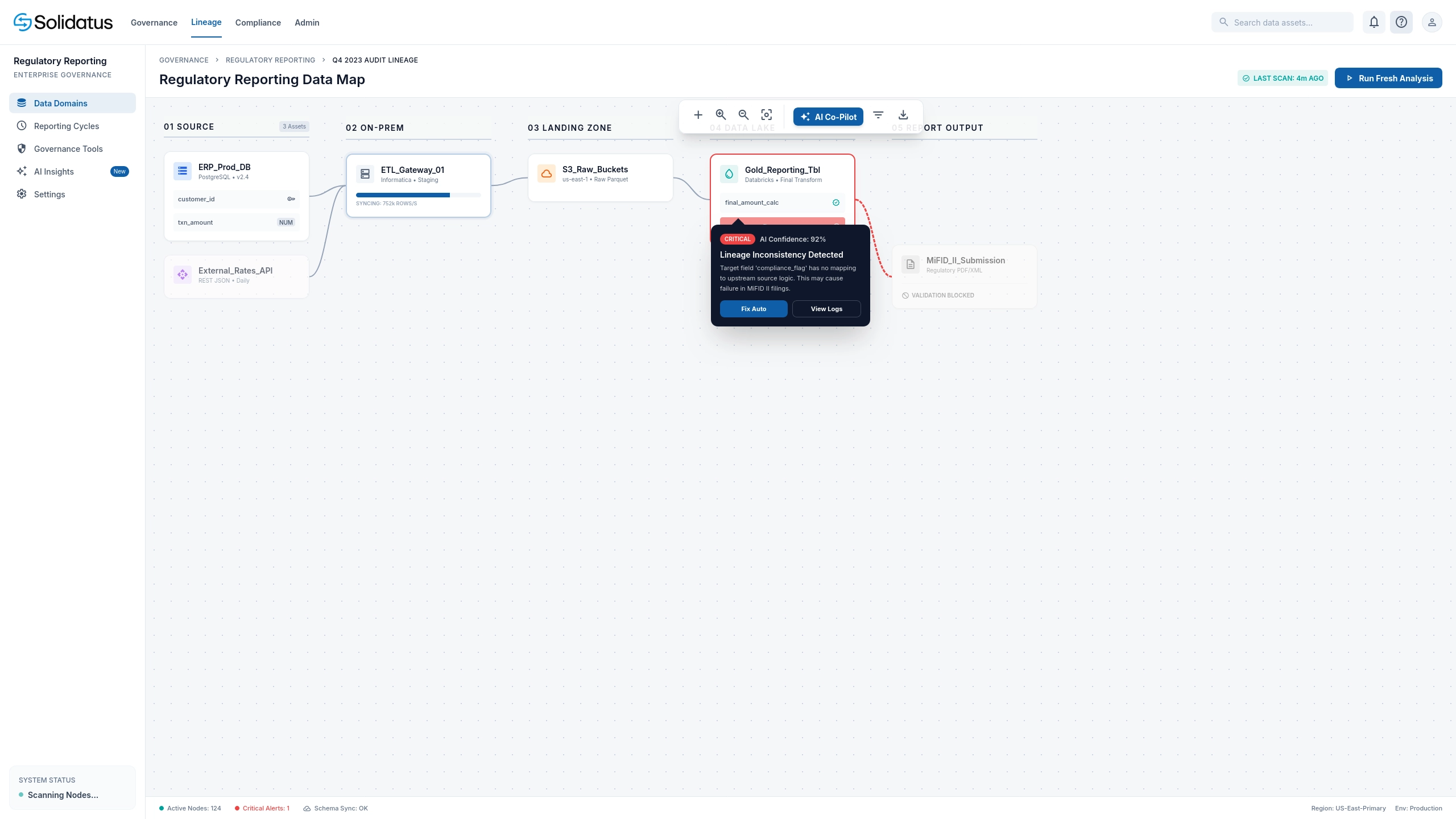
What others were seeing
- Slow inline editing.
- Difficult merge workflows.
- Low adoption of advanced capabilities.
What I recognised
These were symptoms of a structural problem. Investigation and remediation existed in the platform, but the experience made record maintenance feel like the primary job.
Options and trade-offs
| Path | Immediate benefit | Strategic limitation |
|---|---|---|
| Optimise entry and editing | Faster maintenance work. | Makes the existing data-entry mental model more efficient. |
| Automate remediation | Maximum speed for routine issues. | Introduces trust and governance risks where human judgement is required. |
| Guided investigation and remediation | Connects insight to action while preserving control. | Chosen: changes the behaviour of the product without removing expert oversight. |
The system I established
I replaced scattered node editing with a clear investigation sequence. Each stage exposes the evidence and control needed to make the next decision.
- DetectSurface a quality signal.
- PrioritiseSeparate urgent issues from background noise.
- InvestigateInspect the affected entities and relationships.
- Understand provenanceTrace where the issue entered the system.
- ReviewConfirm the proposed change and its consequences.
- ResolveApply the action with human oversight.
Adoption was part of the architecture
Contextual guidance was not added as a layer of tooltips after the redesign. I used onboarding to teach the new operating model at the point where users moved from familiar maintenance tasks into investigation and remediation.
What changed
| Behaviour shift | Observed impact |
|---|---|
| Workflow paradigm | Users moved from locating issues to resolving them in one flow. |
| Resolution speed | Anomalies were resolved 25% faster. |
| Feature utilisation | Advanced investigation capabilities moved into everyday work. |